
Bluesman Willy King
A chapter from Pity the Genius: a Journey Through American Music in 33 Tracks

Up at Full Moon Resort we are cooking up a new camp, one for the blues. It will happen in the week of August 8, and include some of the greatest blues exponents that we have left. It put me in mind to send out this piece again. Willie King is part of the vast trove of wonderful musicians who basically nobody knows about. I cherished this experience at the time and I cherish it still. I can't help but wonder what's become of him, and this juke joint that I visited. As a guitar player in America, the blues is part of everything I do. Whether overt or incremental, it's there.
If you want to buy the book, here it is. Or write to me!
Oh yeah, please subscribe to this page….
https://www.amazon.com/Pity-Genius-Journey-through-American/dp/1955604169
Willie King
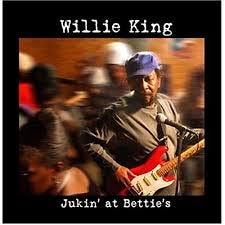
I wrote the bulk of this piece in 2002 not long after my first journey south to the Delta. It was a hejira of sorts. I’d just broken up with my first wife, and I was lost. I visited Dockery Farms, Beale Street, B.B. King’s birthplace in Indianola, a juke called Po Monkey’s in Clarksdale, and Bettie’s Place, the one detailed below.
As I was considering writing about Charlie Patton, who as at the root of all Delta Blues, and possibly the hub of all American roots music, I wondered what more could be said about one of the most haunting, impactful, and prodigious talents in guitar history. Many a researcher has weighed in. It occurred to me I’d met someone who was a living link to that history, Willie King.
Patton was as far as we know the first “eclectic” guitar showman. He played hillbilly songs, deep blues, gospel, and nineteenth century parlor songs. Patton was mixed race, probably part Indian and Caucasian, and in that light we can see he was a prophecy, the blueprint for performers of all races who came after. It’s said that his voice was so loud you could hear it 500 yards away. His singing style, which influenced Howlin’ Wolf, has its aural roots in a type of African singing called voice chording. Though he played stages in New York and Chicago, his main gig was the plantations that surrounded him. When I hear his recordings, whether a rag, moaning blues, or a story song, I try to picture the physical space. What was a Saturday night like at Dockery Farms, where a one -man band brought brief respite to the plantation workers in some shack far from the Big House? What was that party like? No bass and drums, no PA, just a wild looking fellow in the corner wailing away on a steel guitar, singing as loud as he could as the folks drank, sweated, and danced, shedding the weight of the work week. My experience at Bettie’s place may have been as close as you can get to that scene in the 21st century.
Willie Smith, born in 1943, was part of that Delta lineage. He wasn’t an innovator like Patton or Robert Johnson. But you hear the line going all the way back to W. Africa, in the way he lays down a one chord boogie, patient and urgent at the same time, his rough-edged voice making you hurt and smile at the same time. Willie King never chose the touring life, and he hardly recorded at all. His calling was to show up at his neighborhood spot every week. This was his community, the fellow farmers. I’m indebted to his band member, TK, for inviting me to one of the most wondrous gigs I’ve ever done.
Here’s a cut of Willies’
Juke Joint Prophecies:
Heat’s filling my head to bursting. There’s a stone on my chest that I can’t relieve. Wheels are my consolation. “Who are you?” the spirits ask, and Charley Patton is laughing at me, perched atop a weathervane, wondering why I thought I was so special.
Guitarist/ bassist TK, is driving northeast towards the Alabama border. The vents in his 70’s Toyota won’t stop blowing hot air, so all the windows are open, and a fan sits beside him, powered by the cigarette lighter. We’re going to Bettie’s Place, a juke joint two hours from Jackson, Mississippi to play with the bluesman Willie King.
Out of Jackson on Highway 20 turning into Highway 56 past Meridien, then a Rubik’s cube of small roads through farmlands of soybeans and cotton, thumbnail towns, farther and farther from the highway. Every time I think we can’t make another turn, we continue onto more desolate trails, past tumbledown barns, two room shacks, a dog marooned on a lopsided porch, peeling paint on rotting eaves, a middle-aged man under a baseball cap on a rusted red tractor, illuminated swaths of green from shortstraw and longleaf pine. Now it’s dirt roads, with no human in sight. The radio’s on, mostly rock n’ roll and Christian shows. There’s a signal that comes in and out, a preacher howling prophecies, like a caged animal, exhalations that spew out of the speakers in waves of incantatory rhythm. TK says “We gonna make those ladies grind tonight, brother!” He stretches out the word “grind,” so it sounds like guhriiiiiiiiiiiind.
When we finally stop driving it’s as if we’ve arrived at someone’s house at the end of a 40 mile driveway. Except the house is a bare bones shack set on concrete blocks with the words “Bettie’s Place” scrawled across the front entrance.
The joint is about sixty feet long and 25 feet wide and every inch is beat up. The roof dips and weaves with shingles missing. Clapboards rot at the edge, and the screen door won’t close properly. To the side of the front door, tacked to the facade, are decades old signs for Budweiser and RC Cola. The inside walls are simply particle board, unpainted, not a piece of sheet rock in sight. There’s a small corner for the band under a low ceiling, a modest size dance floor with a tiny bar at the end, and a small room for a pool table.
TK and I haul his bass amp and my guitar amp into the joint and sit outside in two folding chairs waiting for the band. The drummer drives in, a big bruiser who looks mean but talks kind, a teenager walks in behind him, the drummer’s son, joining us on guitar. Willie pulls up in a white pickup truck.
Willie’s in his sixties, stout and strong, with a chiseled jaw and a goatee. His face is inscrutable, he may love you or hate you, no way to tell. He wears a collared shirt, jeans, and dress shoes, topped by a Cleveland Indians baseball cap. He sets up his amp quick, nonchalant, barely speaking, appraising me with a nod and a near bone-shattering handshake, his big paws calloused from farm work, engorging my unblemished hands. As dusk settles in people begin to show up, and here more than anything, is what makes me feel as if I were time-traveling back fifty years.
Half the people arrive not by car, but by simply appearing through the fields. They show up from all sides, not just walking down the dirt road that we’d come in on, but by literally traveling crop rows from nearby farms. This was how music was made for thousands of years before the dawn of the car, train, plane. Music was made for a small community, by people in that community, social glue of a neighborhood. What do you do on Saturday night? Head to Bettie’s Place. I feel nostalgic for a world that ended long before I was born.
TK has a big grin on his face, “Come on, Joel, we gonna make it roll in here tonight. Find us some ‘shine to drink too!” Willie sits on a folding chair next to me, unsmiling, counts off a tune, a mean, scarred, beautiful voice, and he strums the simple chords on a beat-up white Stratocaster with his thumb. I settle in, trying my best to speak his language. He’s an old-school Bluesman, doing classic repertoire from the 40’s and 50’s, but also his own tunes. Willie has an idiosyncratic way of playing rhythm, hitting bass notes with his thumb and picking some of the notes with his fingers, a style that’s his own and yet clearly developed not listening to Clapton or Buddy Guy, rather the old-timers like John Lee Hooker, Son House, and Robert Johnson.
He nods to me when he wants me to solo and I dig back into that old sound, the guitar licks that are at the root of my generation’s idols, Hubert Sumlin, Hendrix and Duane Allman. I try not to wear out my welcome, making damn sure not to throw in any jazz licks. After one solo Willie turns his head to me while still playing and says, “Can you turn that damn thing down?”
The dance floor begins to fill, and sure enough the ladies are grinding, and the place is so small the dancers are almost on top of the band, swinging butts and funky footwork right up next to my guitar strings. I do one wild lick that causes a couple of people to look up from the dance floor and scream their delight, and one lady yells, “White Boy can Play,” while another says, “Guitar man makin’ my titties hard!”
Willie calls the classic Spoonful, and he puts a delicious native twist on it, an extra beat in the turnaround phrase, the kind of anomaly that used to happen all the time, until modern life straightened all the kinks.
We break and I go to the bar, where they serve just PBR and Bud, and it’s $1.50 a pop. Men and women chat outside on lawn chairs, or on the hood of a car, the back of a pickup. A couple of old men sit on the front steps, dressed in pressed white shirts and black slacks, one of them wearing a white fedora with a feather in it. The dialect is so thick I can hardly understand the words, slow and molasses-like. Everyone knows each other, they talk about the weather, gossip about a neighbor. The older guys sit in silence most of the time, expressionless, holding a beer, maybe nodding to someone who ambles by. Folks are friendly, they ask me where I’m from, and how I came to learn the blues, glad that I’ve come to their favorite spot. The greenery of the trees encircles the yard, a spotted mutt ambles by and then trots back into the woods, the sun eases behind the trees.
That permanent ache in my heart, the stone on my chest, has lifted, levitated off my body by the gritty, funky music.
TK says, “Time to make the ladies guhriiiiiiiind again,” and we rock some more tunes, one chord boogies, 12 bar shuffles, one R&B groove in the style of Curtis Mayfield. Willie has the dancers in the palms of his gargantuan hands, as couples shake all kinds of booty on the gouged wood floor. He never smiles, hardly introduces the tunes, bows his head under the baseball cap, his band listens close, follows his lead.
We end around ten o’clock, and Willie takes my hand one more time after he sets down his guitar, stares at me for a moment. His eyes are deep set brown, blood shot, wrinkles around them, he seems to take my measure. There’s no way to know what he’s thinking, he’s staring inside me and past me. Willie finally says, “You’re welcome in my band anytime.” He then hustles off after he gets whatever small sum Bettie has for him. Doesn’t say anything else to the band or the audience, just climbs into his car and hauls off.
I talk with the drummer and his wife for a few minutes, “What’s it like up there in New York,” he asks, “I want to get up there soon.” I tell him it’s so full of musicians it’s easy to forget you exist, that every kind of music invented by the hand of man is going on there, and he should visit.
One of the older gents still on the stoop gives me a kindly nod as I walk by. He’s in dress black pants and a button up white shirt, looks like he’s been sitting in the same place for a thousand years. I wonder if anything can phase him, whether if the four horsemen of the Apocalypse rode straight towards him he’d budge. An affirmation from a man like that is something you carry back home with you, can’t hang it on the wall, or sell yourself with it— it’s medicine, a healing potion for an ailment you never knew you had.
People are dispersing quickly, starting engines and raising dust, walking back across the fields, laughing, waving goodbye to each other. Crickets sing, a gentle breeze tickles my skin. You can smell the moist, rich earth—it’s night time at the border of Alabama and Mississippi in a town that has no name, on a Spring night where human goodness is overflowing.
We follow a dust trail back towards the known world, through the farmlands and darkened porches. I feel the breath of the ancestors on my neck and arms, and they’re singing to me, telling me they’re glad that I came their way.